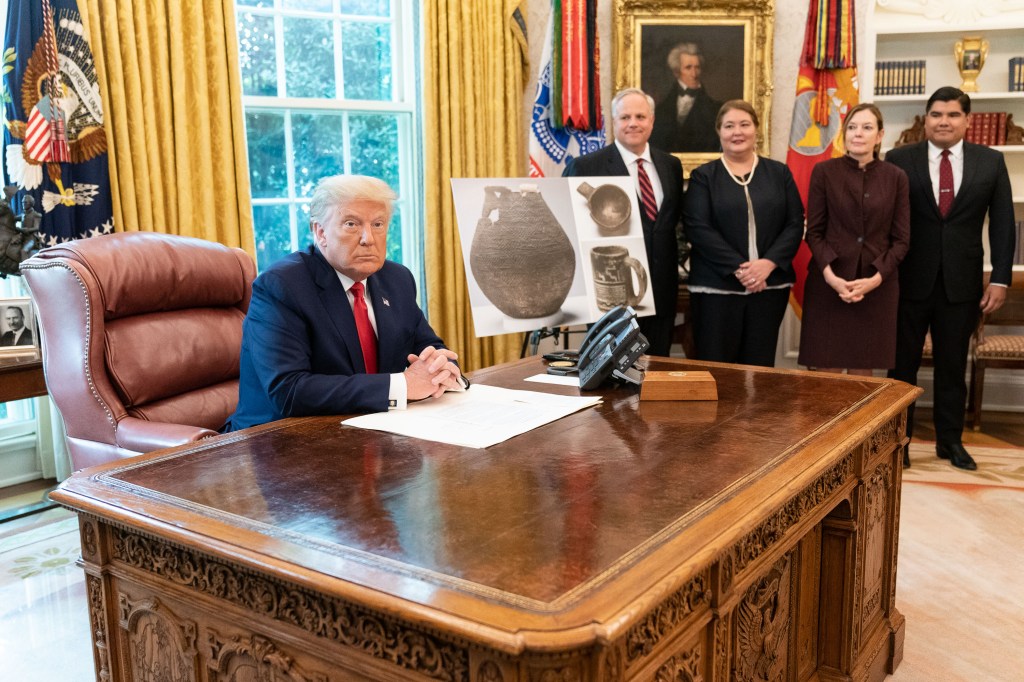
Photo: The White House from Washington, DC / President Trump in the Oval Office (Public domain), via Wikimedia Commons (source)
The United States barred a list of Canadian products from entering the country starting 12:01 a.m. ET on Tuesday, Sept. 29, under presidential proclamations that ban certain alcoholic beverages, dairy goods and motor vehicles, according to the Federal Register and a White House fact sheet.
President Donald Trump signed the proclamations on Sept. 8 under the Tariff Act of 1930's Section 338, the White House said. The fact sheet said the bans answer Canadian counter-tariffs on roughly $20 billion in U.S. exports and what the administration calls continued discrimination against U.S. alcohol, dairy and motor-vehicle commerce.
Jacob Jensen, who leads trade policy work at American Action Forum, told the Associated Press the bans cover about $967 million of Canadian imports based on 2025 data, with alcoholic beverages making up about 87% of that total. The AP reported that two-way annual trade between the countries is about $880 billion.
What is covered
The White House said the alcohol and dairy bans apply to products that had already been hit with 50% Section 338 tariffs earlier in the summer. The motor-vehicle proclamation covers certain Canadian products in that category; Bombardier Recreational Products told the AP its Can-Am Spyder and Canyon three-wheelers "will be excluded from importation into the U.S.," while saying most production and shipments for the current season were already finished.
Trade attorney Patrick Childress, a former U.S. trade official, told the AP that many of the listed goods were already uneconomical to import because of the 50% tariffs, so the bans may have a limited near-term commercial effect.
The Hill reported that U.S. businesses imported roughly $382 billion of goods from Canada last year, citing Census Bureau data, and that Trump last month imposed 50% tariffs on $27.6 billion of Canadian products that Canada matched “dollar for dollar.”
What each side says
Trump told reporters in the Oval Office on Monday that Canada has “treated the United States very, very badly,” the AP reported, and said he expects a deal that is “fair.” A spokesman for Canada-U.S. Trade Minister Dominic LeBlanc said Ottawa’s priority is “protecting and supporting Canadian workers, farmers, families, and businesses from these unjustified actions,” according to the AP.
The White House fact sheet said Section 338 allows the president to exclude products when a foreign country maintains or increases discriminatory practices, and that the administration is also refining earlier July tariff lists by removing some items, such as rock salt and cement, and adding others, including ATVs and additional dairy products. Those product additions and removals took effect Sept. 15, the fact sheet said.
What's next
The AP reported that the standoff complicates efforts to renew the United States-Mexico-Canada Agreement. Childress said the bans and tariffs so far “probably won’t cause enough economic upheaval to force either party back to the negotiating table.” Trump said Monday he thinks a deal will be made; Canadian officials have not announced new countermeasures tied to Tuesday’s effective date.
Sources
- The White House: Fact Sheet: President Donald J. Trump Responds to Canada’s Retaliation (2026-09-08)
- Federal Register: Proclamation 11061 — Excluding Certain Canadian Products From Importation (Alcoholic Beverages) (2026-09-14)
- Associated Press: From motorcycles to booze, US ban on $1 billion worth of Canadian imports goes into effect (2026-09-29)
- The Hill: Trump administration ban on $1B in Canadian imports goes into effect (2026-09-29)
Motion Media News corrects errors promptly. To report one, email hello@motionnews.studio.





.jpg)