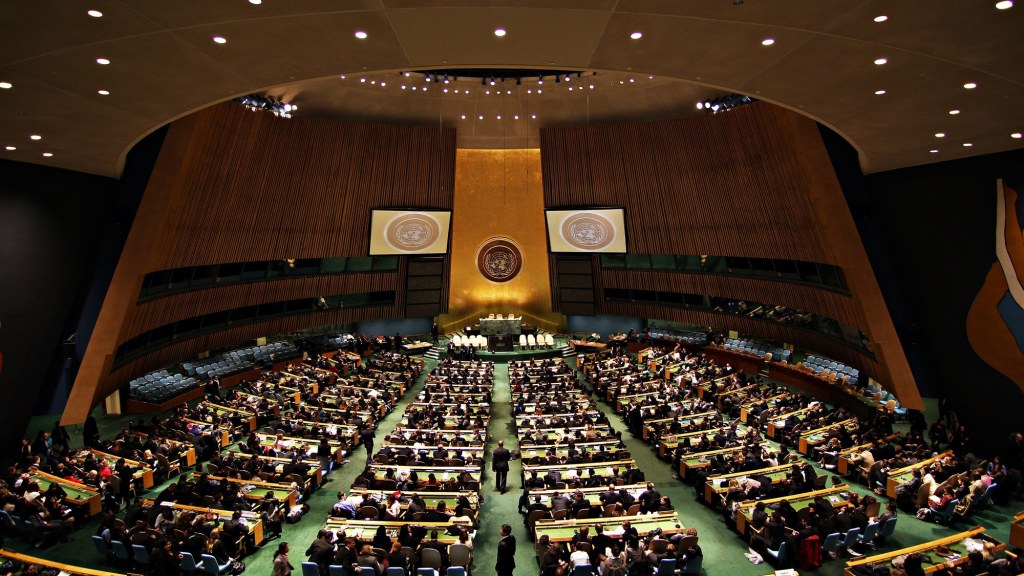
Photo: Basil D Soufi, CC BY-SA 3.0 (https://creativecommons.org/licenses/by-sa/3.0), via Wikimedia Commons (cropped) (source)
President Trump used his address to the U.N. General Assembly on Tuesday, Sept. 22, to defend the war with Iran and to say he faces a choice between a deal with Tehran and destroying its government. Hours later, he said his envoys had met Iranian officials on the sidelines of the gathering.
"I have a big decision to make," Trump said, according to the Associated Press. He asked whether a deal would let Iran "rebuild and create a far greater country than it ever was before," or whether he should "annihilate the Islamic Republic and do it quickly." He also said, "I believe we'll make a deal," UN News reported.
Trump called Iran "the number one sponsor of terror," said "I will never allow Iran to have a nuclear weapon," and urged governments to support the "complete economic isolation of Iran" until it stops attacking commercial shipping and backing terrorism, according to UN News. He also called on Iran to fully reopen the Strait of Hormuz, AP reported. Most of Iran's delegation walked out during the remarks.
Envoys meet Iranians
After the speech, Trump told reporters that envoys Steve Witkoff and Jared Kushner had met Iranian officials at the U.N. "It was a very good meeting," he said, adding that the officials were "not the highest level, but it's something." He gave few details. AP said the contact followed months of stalled communication after a ceasefire brokered in June collapsed. Secretary of State Marco Rubio said earlier in the day that Trump was open to meeting Iranian President Masoud Pezeshkian.
Trump also met leaders and senior officials from the six Gulf Cooperation Council states and Jordan to discuss the war, and held talks with British Prime Minister Andy Burnham, Japanese Prime Minister Sanae Takaichi and Ukrainian President Volodymyr Zelenskyy, according to AP. After the address, he signed a security agreement with the leaders of Denmark and Greenland.
Other themes
Trump said he had helped end eight conflicts since returning to office, listing disputes including Cambodia and Thailand, India and Pakistan, Armenia and Azerbaijan, and the war in Gaza, UN News reported. He cited the U.S. operation that removed Venezuelan President Nicolás Maduro and announced an oil agreement with Venezuela.
He argued for calling artificial intelligence "superintelligence," saying "Whoever wins superintelligence wins," and that the U.S. would encourage the technology while watching its risks. He called the International Criminal Court "full of evil people" and criticized the U.N. Human Rights Council, UNESCO and the International Maritime Organization.
The White House summarized the address as a message that "American strength and resolve is back." AP noted that the Iran war has weighed on Republicans' hopes of keeping both chambers of Congress in the midterm elections.
What's next
Trump was expected to meet Venezuela's acting President Delcy Rodríguez informally on Tuesday evening, according to the White House as cited by AP.
Sources
- AP (via TribLive): Trump says U.S. and Iranian officials met Tuesday, shortly after warning he may ‘annihilate’ Iran (2026-09-22)
- UN News: Trump defends military action against Iran, Venezuela, and calls for rebrand of AI (2026-09-22)
- The White House: President Trump at the United Nations: "While Others Have Talked, I Have Acted" (2026-09-22)
Motion Media News corrects errors promptly. To report one, email hello@motionnews.studio.
Added to the Motion Media archive on Sep. 28, 2026.



.jpg)