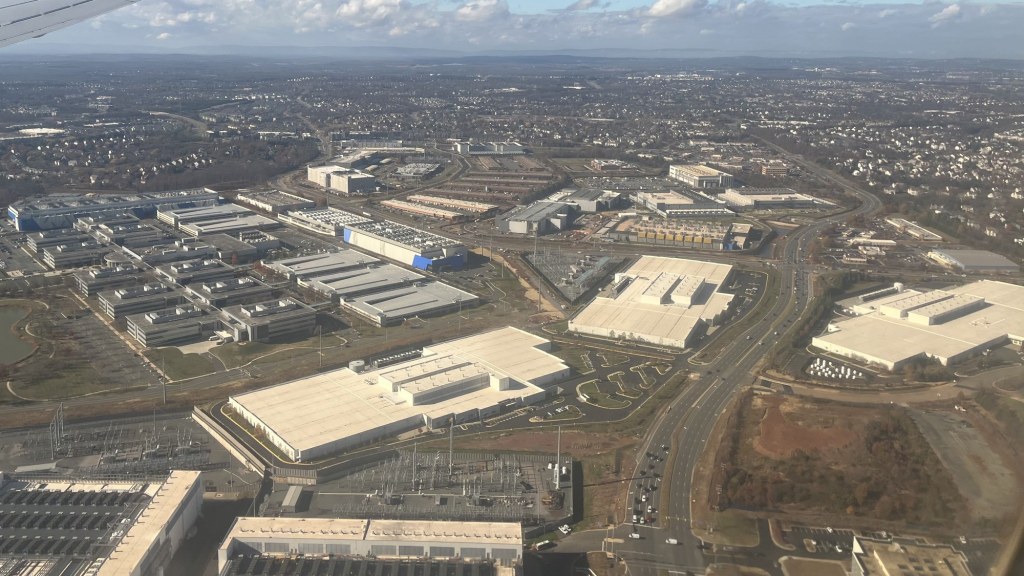
Photo: Theodore Christopher (CC0 1.0), via Wikimedia Commons (source). Aerial view of data centers near Ashburn, Virginia (file photo, Nov. 26, 2025).
The fight over who pays for America’s artificial-intelligence buildout is no longer a zoning skirmish. It is a Senate floor fight, a midterm issue in Ohio, and — as of Monday — an organized alliance of AI companies and building trades that wants rules without nationwide pauses.
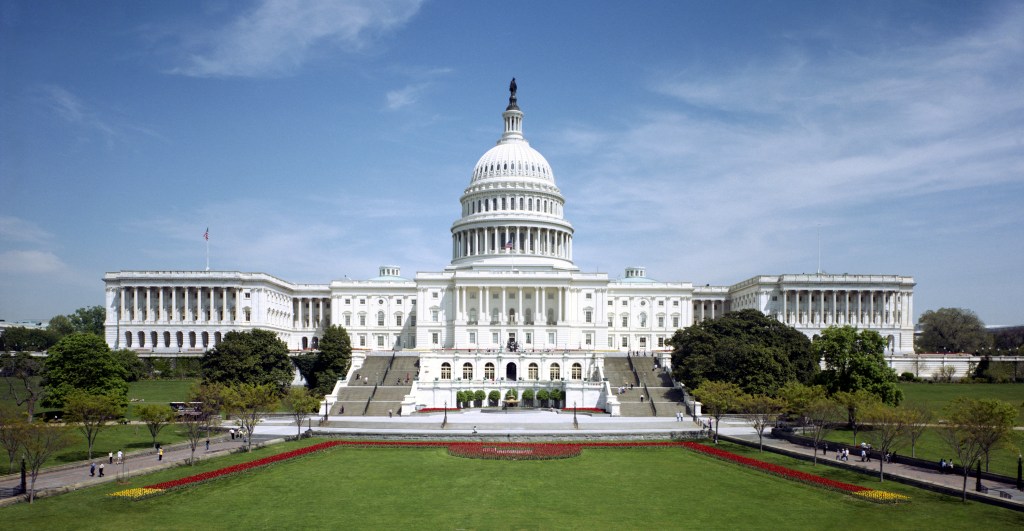
Senate Democratic Leader Chuck Schumer is working to defeat the Ratepayer Protection Act (S.5028), Sen. Jon Husted’s (R-Ohio) bill that would push large data centers to cover more of their own power-infrastructure costs, The Hill reported on Monday. The House passed the measure 417-3 on Sept. 16. Senate Majority Leader John Thune is expected to file cloture Monday and tee up a first procedural vote Wednesday, The Hill and Punchbowl News reported. Motion Media News Staff covered the Senate maneuvering here.
What the bill would do
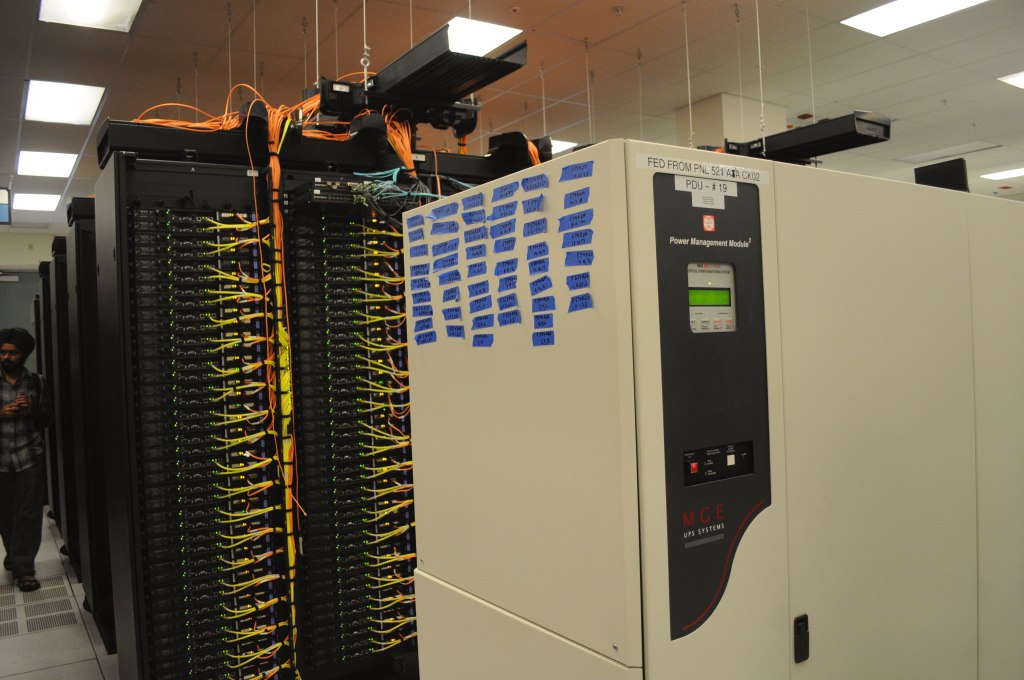
According to CNBC, the legislation would create a framework states could adopt under which AI data centers drawing 100 megawatts or more would cover costs of new generation, transmission and related infrastructure rather than shifting those costs onto other ratepayers. Husted, in floor remarks posted by his office, said America is expected to build “the equivalent of 1,000 major data centers during the next five years,” with more than 2,000 projects proposed or tracked. His principle: “if you create the cost, you should pay the cost.”
On Sept. 17, Husted sought unanimous consent to pass the House-passed bill; Sen. Martin Heinrich (D-N.M.), ranking member on Energy and Natural Resources, objected, CBS News and CNBC reported. Heinrich said the bill “falls short” and promoted his own GRID Savings Act. Schumer later called Husted’s bill a “fraud,” saying it is “voluntary, no company has to do it,” and contrasting it with a Democratic alternative he described as “mandatory,” The Hill reported.
Not every Democrat wants a flat block. Sen. Chris Van Hollen (D-Md.) told The Hill the bill is “a tiny step forward” and favored opening debate for amendments — while refusing final passage without stronger protections. His Power for the People Act would push separate rate classes for data centers and ask FERC to make large loads cover the transmission upgrades they trigger. Sen. Tina Smith (D-Minn.) called the push “kind of a political bailout” for Husted; Whip Dick Durbin told The Hill he had not yet taken a position.
The politics are sharpest in Ohio. Former Sen. Sherrod Brown has made data centers a central campaign issue against Husted; Absecon Group figures cited by The Hill put Brown’s online advertising about data centers above $430,000. A YouGov poll of 1,000 likely Ohio voters earlier this month found 75 percent opposed or strongly opposed local data center construction, The Hill reported.
Industry and unions form a different front
While the Senate argues over rate design, the industry is organizing for 2027. In an exclusive published Monday, Axios reported that AI companies, private equity firms and unions are forming a multimillion-dollar coalition — the American Infrastructure Alliance — to make the case for “responsible growth” in seven states: Texas, Georgia, Ohio, Iowa, Pennsylvania, Indiana and South Carolina. Backers include Blackstone, OpenAI, QTS and SoftBank Group, plus unions including the International Brotherhood of Electrical Workers (IBEW), SMART, the Insulators, the Iron Workers and the United Association of Plumbers and Pipefitters.
The group wants standards and guardrails with state and local officials — and, Axios reported, hopes to head off construction moratoriums. Tag Greason, co-CEO of Blackstone-owned QTS, said responsible growth “requires clear expectations for everyone involved.” IBEW International President Kenneth Cooper warned that “blanket bans on necessary infrastructure projects would set back our economy and threaten good middle-class jobs.” Axios reported the coalition’s own Ohio polling found data centers deeply unpopular (67 percent unfavorable versus 18 percent favorable), but that numbers improve when projects pledge lower electricity costs, jobs and tax revenue.
Local brakes already on
On Sept. 22, Prince William County, Virginia, supervisors voted 8-0 to end most by-right data center development, forcing future projects outside a reduced overlay to seek a special use permit, WTOP/InsideNoVa and the Prince William Times reported. A 90-day grace period applies. A day later, Chicago Mayor Brandon Johnson and three aldermen introduced a 12-month moratorium on new data centers and material expansions while a city task force writes rules on energy, water, air and quality of life, the City of Chicago said. “Chicago is open for business, but we are not for sale,” Johnson said. Motion Media News Staff summarized both moves here.
What’s next
Thune’s Wednesday procedural vote is the immediate test: whether Schumer can hold enough Democrats to sink the motion to proceed, The Hill reported. Even if debate opens, Democrats could still block final passage. Separately, the American Infrastructure Alliance is aiming past November — at 2027 statehouses and the longer AI infrastructure fight.
MOTION MEDIA TAKE
America does not win the AI race by pausing the factories of intelligence. It wins by building power and compute at home — and by making the largest new loads pay for the wires, substations and generation they force onto the grid.
That is the Hamiltonian answer. The American System was never “subsidize whoever shows up.” It was build the infrastructure that compounds national capacity, then set rules so private capital carries its own incremental cost. Husted’s Ratepayer Protection Act is a modest version of that principle: large load customers should cover the full incremental cost of serving them. The House understood that, 417-3. If the bill’s framework is too soft, the Senate should harden it — FERC discipline for transmission upgrades, clearer state rate classes, real enforceability — not kill the only bipartisan vehicle on the floor so the midterms can keep screaming about bills without fixing the grid.
Local anger is real. Families should not open an electric bill and discover they are financing a hyperscale campus next door. Fair cost allocation is how you keep communities open to building. Blanket moratoriums and by-right shutdowns are how you export the next decade of AI capacity to places still pouring concrete. The IBEW and the pipefitters joining OpenAI and Blackstone is not a plot against ratepayers; it is a reminder that data centers are also construction jobs, tax base and the physical layer of American AI.
Build the power. Make the big loads pay their way. Keep the shovels moving. That is how the United States industrializes for the intelligence age instead of litigating itself out of it.
Sources
- The Hill — Schumer, Dems at odds as leader aims to kill Ohio Republican’s data center bill (Sept. 28, 2026)
- Axios — Exclusive: AI giants, unions join forces for data center fight (Sept. 28, 2026)
- Punchbowl News — Senate’s preelection finale (Sept. 28, 2026)
- CBS News — Senate Democrat blocks House-passed bill… (Sept. 17, 2026)
- CNBC — Bill to curb AI data center utility costs hits snag in Senate (Sept. 17, 2026)
- Sen. Jon Husted — Ratepayer Protection Act blocked from passage (Sept. 17, 2026)
- Congress.gov — S.5028 Ratepayer Protection Act
- Motion Media News Staff — Schumer moves to block Husted data center ratepayer bill (Sept. 28, 2026)
- WTOP/InsideNoVa — Prince William ends by-right data centers (Sept. 23, 2026)
- Prince William Times — County moves to end by-right data center development (Sept. 22, 2026)
- City of Chicago — Data Center Moratorium Ordinance (Sept. 23, 2026)
- NBC Chicago — One-year ban proposed by Mayor Johnson (Sept. 23, 2026)
- Motion Media News Staff — Prince William / Chicago local limits (Sept. 23, 2026)