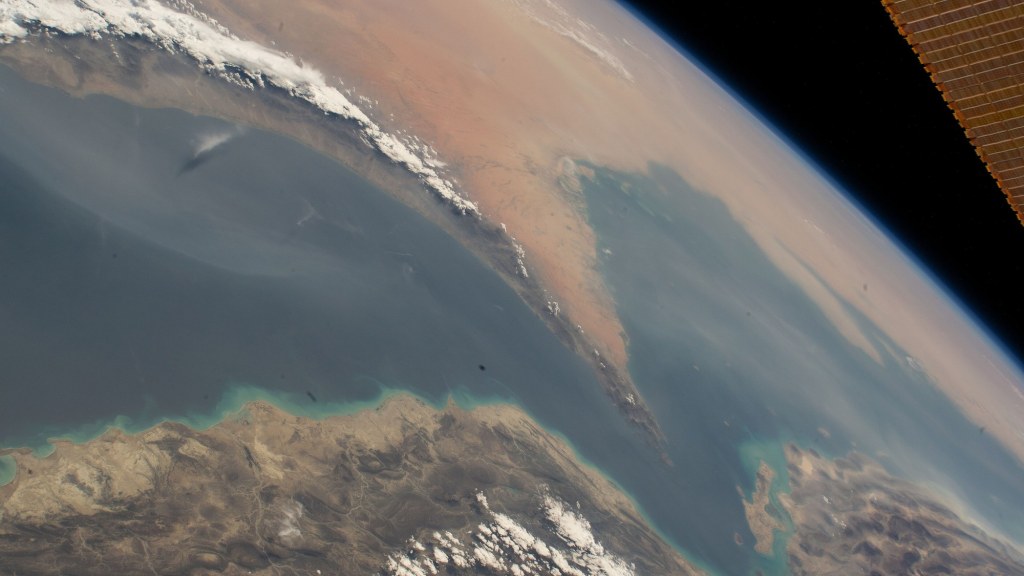
Photo: NASA (Public domain), via Wikimedia Commons (source)
President Trump said Saturday, Sept. 26, that he was rejecting an Iranian proposal to reopen the Strait of Hormuz within a week and restart negotiations, telling reporters at the White House that the deal "would not be acceptable."
"They want to make a deal where they open the strait immediately because they're losing so badly," Trump said, according to The Hill and NPR. He said 29 ships had left the strait the previous night and that the U.S. has "total control" of the waterway. NPR said he did not explain his objections further.
What Iran offered
Iranian Foreign Minister Abbas Araghchi told reporters at the U.N. General Assembly in New York that Iran had passed a "concrete seven-day plan" to Washington through Qatar. "If the necessary conditions are met, the strait can be reopened, and normal maritime passage restored within seven days," he said. "The choice now rests with the United States."
Under the plan as described by Araghchi and reported by The New York Times, hostilities in Iran and Lebanon would stop during the seven days, the U.S. would release billions of dollars in frozen Iranian assets, grant waivers on oil sanctions and end the blockade of Iranian ports, and Iran would reopen the strait only on the final day, The Hill reported. Comprehensive talks on Iran's nuclear program would follow.
Araghchi said the U.S. steps were largely already in a 14-point memorandum of understanding the two sides signed in June, which collapsed amid renewed fighting in July. That deal gave 60 days to restart nuclear talks. Araghchi said Washington could complete its steps in four or five days.
Iranian President Masoud Pezeshkian told CBS, in an interview NPR said was set to air Sunday, that Iran would admit U.N. nuclear inspectors if the U.S. accepted the proposal and resumed nuclear talks.
The U.S. position
Before the rejection, a U.S. official told The New York Times the administration was holding constructive talks through mediators but would not rush into an agreement, according to The Hill. The Wall Street Journal, citing U.S. officials, reported that Trump doubts Iran would honor the deal and has told officials he is considering renewed strikes, The Hill said. On Truth Social Saturday, Trump repeated that Iran cannot have a nuclear weapon.
NPR reported that Iran first shut the strait following U.S. and Israeli strikes on the country on Feb. 28. The Hill noted that roughly 20% of global oil supply normally passes through the waterway.
What's next
Araghchi said the seven-day clock would start as soon as Washington accepts. No new talks had been announced as of Saturday.
Sources
- The Hill: Iran pitches 7-day plan to restart US talks, reopen Strait of Hormuz (2026-09-25)
- The Hill: Trump rejects Iran’s 7-day plan to end war, expects bombing to resume post-midterms (2026-09-26)
- NPR: Trump calls Iranian plan to reopen Strait of Hormuz not ‘acceptable’ (2026-09-26)
Motion Media News corrects errors promptly. To report one, email hello@motionnews.studio.
Added to the Motion Media archive on Sep. 28, 2026.