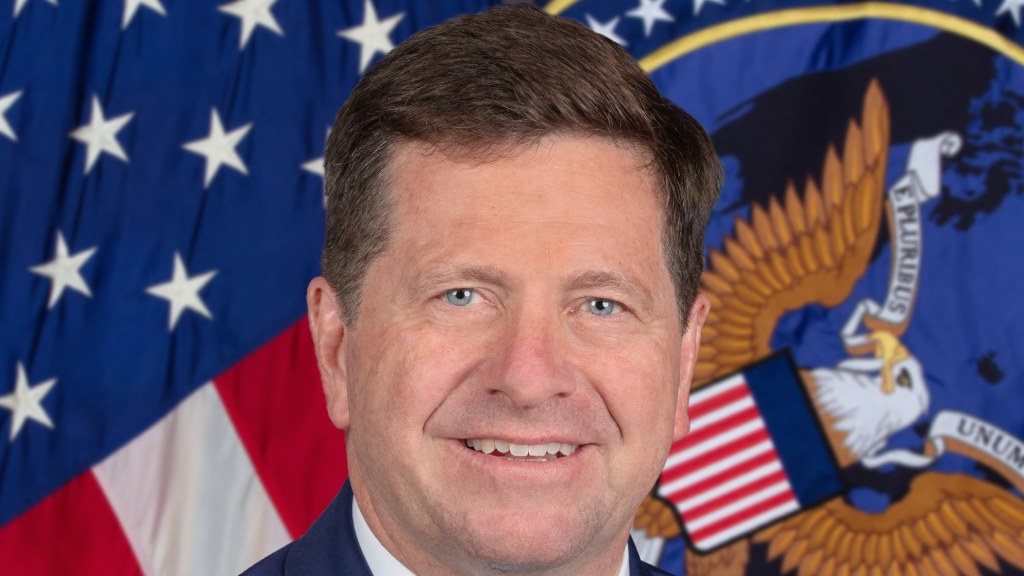
Photo: Office of the Director of National Intelligence (Public domain), via Wikimedia Commons (source)
President Donald Trump on Sunday, Oct. 4, announced a new federal body called the Super Intelligence Force and put Director of National Intelligence Jay Clayton at its head, according to his post on Truth Social, published at 8:23 a.m. ET.
Trump wrote that the group is "tasked with coordinating the effort of the Federal Government to ensure that America continues to lead the World in Super Intelligence." He listed its leaders as Clayton; Federal Trade Commission Chairman Andrew Ferguson; Emil Michael, the Pentagon's under secretary for research and engineering and its chief technology officer; and Scott Kupor, who heads the Office of Personnel Management. The force will report to Trump and to Susie Wiles, his chief of staff, the post said.
According to the post, the body will handle the government's dealings with "Consumers, Public Interest Groups, Religious Organizations, Critical Infrastructure Providers, and Super Intelligence Companies."
Who is in charge
NPR reported that the announcement makes Clayton the White House's new AI czar. The Hill said it was not clear whether the post formally names him to that role. NBC News had reported on Friday that Trump was expected to give Clayton the title. The previous AI czar, venture capitalist David Sacks, left the job when his stint as a special government employee ended, NBC said.
Clayton chaired the Securities and Exchange Commission and later served as U.S. attorney for the Southern District of New York before he was confirmed as director of national intelligence this year, NPR reported. In a CNBC interview last month he described super intelligence as a "national security issue" and argued against calls to pause development, saying, "I don't think any American should think that that's a good strategy," according to NPR.
Citing The Wall Street Journal, TechCrunch reported that Clayton will chair the force with Ferguson, Michael and Kupor as vice chairs. The group's charter tells it to "develop plans for responding to SI-enabled threats to our society, while preventing overregulation and regulatory capture that would stifle innovation and competition," TechCrunch said, citing the Journal.
How it got here
The announcement follows a Sept. 29 White House gathering at which executives from companies including OpenAI, Anthropic, SpaceX and Google signed a voluntary AI safety pact, BBC News reported. The same day, Trump signed an executive order directing federal agencies to use "Super Intelligence" in place of "artificial intelligence" in official communications, the BBC said.
Critics of the administration's approach want binding rules instead. When Trump first floated the task force in September, Sen. Elizabeth Warren (D-Mass.) said, "Congress cannot meet the pressing threat of AI by just forming another committee," according to the BBC. Congress has not passed a federal law broadly regulating how AI is built or used, NPR noted.
What's next
The force will have 120 days to produce a report on the risks and opportunities of advanced AI, TechCrunch reported, citing the Journal. The White House has not released the charter publicly.
Sources
- Donald J. Trump on Truth Social (via the Trump’s Truth archive): Following the Historic White House Accord on Super Intelligence… (2026-10-04)
- NPR: Trump names national intelligence chief Jay Clayton as new AI czar (2026-10-04)
- NBC News: Trump announces members of ‘Super Intelligence Force’ to coordinate AI policy (2026-10-04)
- The Hill: Trump announces ‘Super Intelligence Force’ led by DNI Jay Clayton (2026-10-04)
- TechCrunch: Trump unveils his new Super Intelligence Force (2026-10-04)
- BBC News: Trump chooses top spy boss to run new AI taskforce (2026-10-04)
Motion Media News corrects errors promptly. To report one, email hello@motionnews.studio.






.jpg)