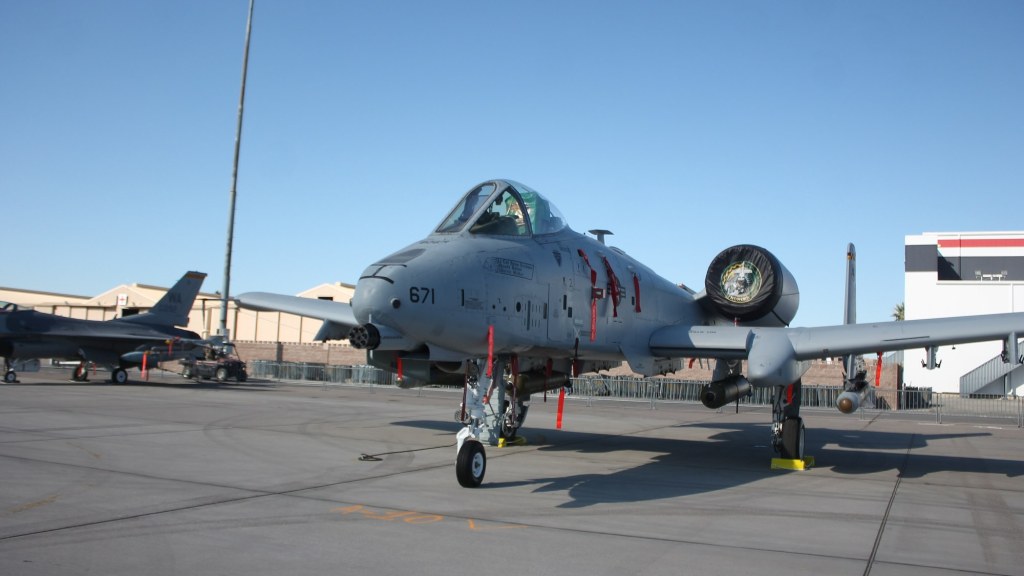
Photo: Noah Wulf, CC BY-SA 4.0 (https://creativecommons.org/licenses/by-sa/4.0), via Wikimedia Commons (cropped) (source)
Nellis Air Force Base in Nevada saw its final A-10 Thunderbolt II take off on Tuesday, Sept. 22, ending almost five decades of Warthog tactics development, testing and training at the base.
Nearly 70 airmen lined the flight line to salute the jet as it took off, the Air Force said in a statement distributed by EIN Presswire. The first A-10 arrived at Nellis in 1977, and the base became the service's main proving ground for how the aircraft is flown in combat, and units there worked on the jet's avionics, software and guided weapons. Over the years, the Weapons School's 66th Weapons Squadron graduated upward of 300 A-10 weapons officers over 100 courses.
Where the mission goes
The Air Force said its close air support capability "is not declining," with expertise and personnel moving to multirole and advanced fighters. The F-35 is picking up ground-support and rescue command duties, and maintainers from the 757th Aircraft Maintenance Squadron are being reassigned to F-35 and F-16 units, according to the statement.
"We are also training F-15 Eagle, F-35 Lightning II and F-16 Fighting Falcon pilots to take on some roles we have had in combat search and rescue," said Lt. Col. Ridge Flick, who leads the 66th. The squadron will continue to train ground specialists such as pararescuemen, combat controllers, combat rescue officers and special tactics officers.
The War Zone reported that spreading the A-10's missions across several fighter communities has drawn skepticism, and that some subject matter experts view the loss of the Warthog community's close air support and "Sandy" rescue expertise as a bigger loss than the aircraft itself.
A fleet winding down
The service had wanted its 162 remaining Warthogs gone by the close of fiscal 2026. That changed after the war with Iran started and A-10s flew the Sandy escort role in April's rescue of two downed F-15E crew members; the Pentagon then said some of the jets would stay in service until 2030 or later, Air & Space Forces Magazine reported.
The broader A-10 enterprise is still shrinking. Arizona's Davis-Monthan Air Force Base, another longtime A-10 hub, in April graduated the last new Warthog pilots it will train and flew its last jets out in July, and the A-10 maintenance depot at Hill Air Force Base, Utah, closed this year, the magazine said. The War Zone said ending operations at Nellis would make reconstituting them difficult and costly.
What's next
The Air Force said lessons A-10 maintainers developed over 50 years in managing airframe fatigue, wing replacements and depot overhauls are being folded into newer flight-line programs. The remaining Warthogs are slated to fly until at least 2030 under the Pentagon's revised plan.
Sources
- Air & Space Forces Magazine: Last Warthog Departs Nellis as Base’s A-10 Era Comes to a Close (2026-09-24)
- U.S. Air Force (via EIN Presswire): Bittersweet departure: Nellis’ last A-10 clears runway for future of close air support (2026-09-22)
- The War Zone: The A-10 Era Is Over At Nellis AFB (2026-09-23)
Motion Media News corrects errors promptly. To report one, email hello@motionnews.studio.
Added to the Motion Media archive on Sep. 28, 2026.