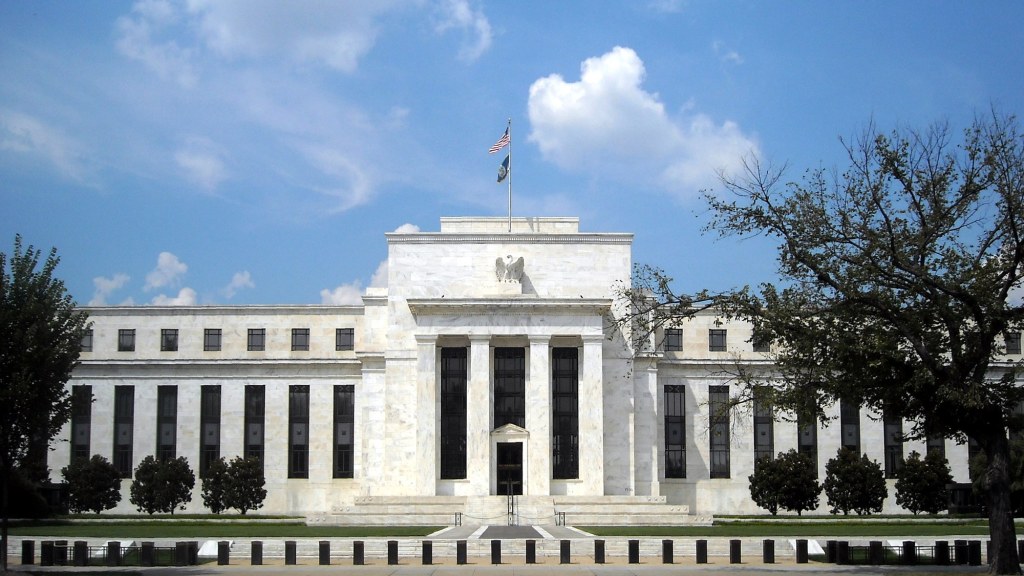
Photo: AgnosticPreachersKid, CC BY-SA 3.0 (https://creativecommons.org/licenses/by-sa/3.0), via Wikimedia Commons (cropped) (source)
The Federal Reserve Board on Thursday, Sept. 24, asked for public comment on two proposals that would set reserve, capital and application rules for stablecoin issuers it supervises under the GENIUS Act, the 2025 law that created a federal framework for dollar-pegged payment tokens.
The first proposal would require those issuers to fully back their coins with permissible reserve assets "such as short-term Treasury bills and certain other high-quality, liquid assets," and would set standardized capital and risk-management requirements, the Fed said. The second would create an application process for state member banks that want to issue stablecoins through a subsidiary, including business plans, financial information and an appeals process.
Reserves and redemptions
According to a Fed staff memo released with the proposals, reserves would have to equal or exceed the par value of outstanding coins at all times and be held separately from other assets. Allowed holdings would include U.S. dollar cash, Federal Reserve balances, demand deposits at insured banks, Treasuries maturing in 93 days or less, certain overnight repurchase agreements, qualifying funds and tokenized versions of some of those assets.
An issuer that fell short of full backing would have to notify the Fed and then liquidate reserves and redeem its coins unless the board approved a plan to quickly restore backing. Issuers would have to publish redemption policies with a redemption period of no more than two business days, which the board could extend in some cases.
The proposal would also carry out the law's ban on paying interest or yield simply for holding a stablecoin and would presume certain third-party arrangements to be prohibited yield payments, the memo said.
Capital charges
For operational risk, the proposal would set a graduated charge on outstanding coins: 2% up to $20 billion, 1.5% from $20 billion to $50 billion and 1% beyond that. A second charge would equal 25% of an issuer's three-year average revenue from activities outside reserve assets, and a loss-based scalar could raise or lower the total. Reserves held as uninsured deposits or undercollateralized repo would carry a 2% capital requirement.
By CryptoSlate's calculation, an issuer with $1 billion in circulation and no other revenue would start with a $20 million baseline charge before adjustments. An issuer still short of its capital minimum after two consecutive quarters would have to wind down its reserves and redeem its coins under the proposal.
The rules would apply to subsidiaries of state member banks approved to issue stablecoins and to uninsured state-chartered issuers with at least $10 billion outstanding that move under Fed supervision. The OCC, FDIC and NCUA have issued their own proposals for the firms they oversee.
What's next
Comments are due within 60 days of the proposals' Federal Register publication. The GENIUS Act takes effect on Jan. 18, 2027, or 120 days after regulators issue final implementing rules, whichever comes first, according to the memo.
Sources
- Federal Reserve Board: Federal Reserve Board requests public comment on two proposals related to establishing a regulatory framework for Board-supervised payment stablecoin issuers under the GENIUS Act (2026-09-24)
- Federal Reserve Board (staff memo): Notice of proposed rulemaking to implement the GENIUS Act with respect to permitted payment stablecoin issuers (2026-09-24)
- CryptoSlate: Fed stablecoin proposal would make circulation a capital cost for supervised issuers (2026-09-26)
Motion Media News corrects errors promptly. To report one, email hello@motionnews.studio.
Added to the Motion Media archive on Sep. 28, 2026.