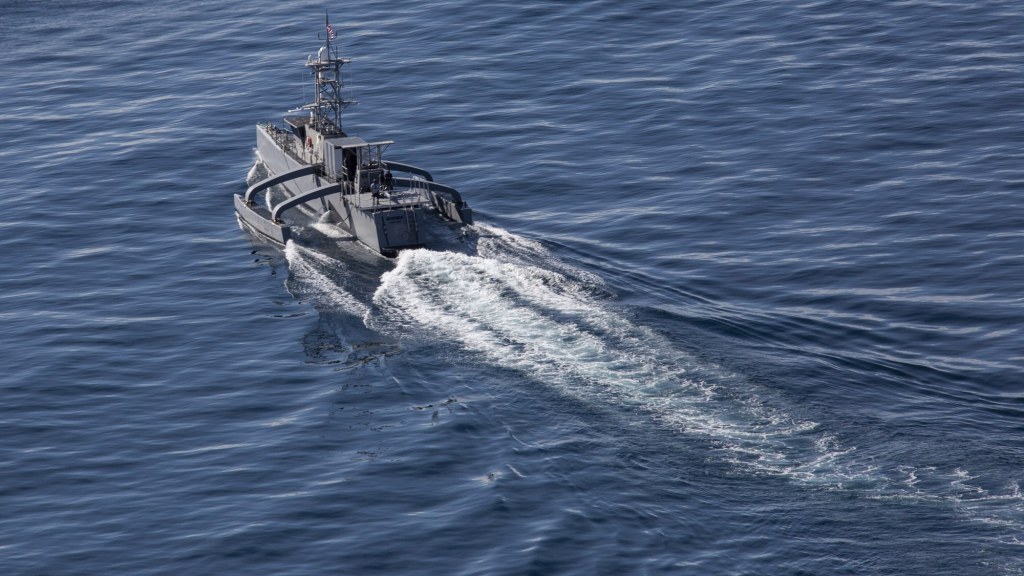
Photo: U.S. Navy / MC2 Lake Fultz (Public domain), via Wikimedia Commons (source)
The Navy opened its new Robotic and Autonomous Systems Warfighting Development Center on Thursday, Sept. 24, to set tactics and training for the service's uncrewed systems, Breaking Defense reported.
The center, known as RASWDC, is based at Joint Expeditionary Base Little Creek-Fort Story in Virginia and is led by Rear Adm. Melvin Smith. It gives drones and autonomous vessels the kind of dedicated warfighting development center the Navy already runs for aviation, surface warfare and mine warfare, according to Breaking Defense.
Chief of Naval Operations Adm. Daryl Caudle assigned the center three core missions: developing warfighting concepts, training sailors, and fielding and testing new technology, DefenseScoop reported, citing an administrative message he issued Thursday.
In that message, Caudle wrote that the Navy's drone work across warfare communities, labs and acquisition offices "has advanced independently within individual domains," and that "the next step is integration." In a separate C-NOte message, he said, "A prototype is not combat power," according to Defense News.
Smith said the center's purpose is to consolidate autonomous efforts in the air, on the surface and undersea "and give them a single home here at Little Creek." At the ribbon-cutting, he said the goal "is not to replace the hard-earned expertise already resident across our Navy. It is to connect it," according to his prepared remarks as reported by Breaking Defense.
How it will work
Defense News reported that the center will first train sailors to employ the systems in combat and then build a curriculum to spread across the fleet. It will also draft rules for how commanders plan missions for autonomous systems, including when communications with human operators are cut, and test new systems at sea, under stress and against simulated threats. Systems that fail will be retired, the outlet reported. Caudle summed up the intended loop in five words: field, employ, learn, improve, scale.
The center will work in tandem with a new acquisition office, the Direct Reporting Portfolio Manager for Robotic and Autonomous Systems, which the Navy created in August to speed buying and fielding of such systems for the Navy and Marine Corps, according to Breaking Defense. Test and training data from the center is meant to feed those fielding decisions.
What's next
Smith is overseeing an implementation plan in stages over the near, mid and long term, covering how the center is commanded, how it relates to other commands and what resources it needs on the way to full operational capability, DefenseScoop reported, citing a Navy press release. The Navy has not given a date for full operational capability.
Sources
- Breaking Defense: Navy launches Robotics and Autonomous Systems Warfighting Development Center (2026-09-24)
- DefenseScoop: Navy creates warfighting development center in Virginia to determine how the sea service will employ unmanned systems (2026-09-25)
- Defense News: US Navy stands up hub to prepare unmanned systems for combat (2026-09-25)
Motion Media News corrects errors promptly. To report one, email hello@motionnews.studio.
Added to the Motion Media archive on Sep. 28, 2026.





.jpg)